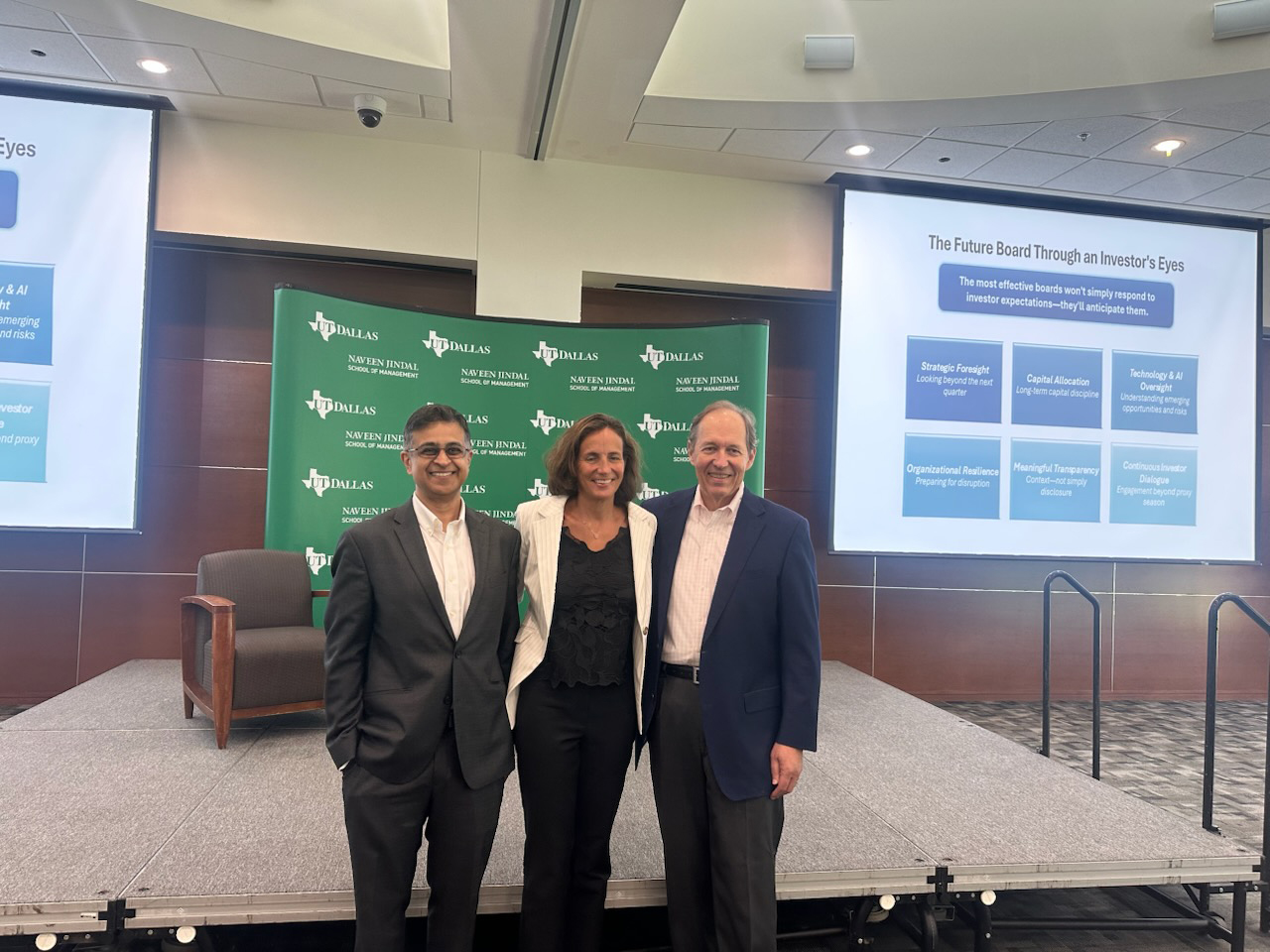
This last week I attended a meeting at UTD’s Institute for Excellence in Corporate Governance, which focused on what investors expect from Board of Directors.
As an IECG advisory board member, helping them with their marketing, social communication outreach, we interviewed the speakers for this session, Laura Minch, CEO, CFA Society, DFW, and Dhruv Maniktala, CIO, Partner, True North Advisors & Western Alternative Strategies.
The hour flew by. The speakers were excellent. What they had to say was very relevant for today’s economy. They focused on the evolving relationship between boards and investors, what accountability means in today’s governance environment, and how in this “new” economy both needed to build stronger investor relationships and work on enhancing board effectiveness. Most relevant was how boards can better anticipate and respond to investor priorities.
What struck me, that while they were talking about what investors expect from boards the parallels between that investors expect and what nonprofit donors expect were very similar.
Both “invest” in the mission of the organization, investors from a profit motive, nonprofit donors in the purpose of the organization. Both have a vested interest in the how the organization performs.
According to Dhruv, “the most effective boards won’t simply respond to investor expectations. They’ll actively anticipate them.”
What he said next, had me applauding, “Boards are very good at telling management what they did wrong, but hardly any boards go back and audit themselves and their own decision making.”
Nonprofit board members are volunteers that wear many hats. They have fiduciary responsibilities to ensure ethical and legal compliance. They are fundraisers and policy makers, guardians of the mission, ambassadors, and public relations experts. They monitor the work performance of the organization and its CEO; the list goes on.
Yet I have found that few boards monitor their own performance. In addition to their governance and fiduciary responsibilities strategic leadership and CEO support- evaluation and accountability, they may forget, overlook, be unaware that the board governs, the CEO manages and good governance means constant evaluation, of what’s being done well are and what needs improvement; on both sides, the boards and management.
The three fundamental fiduciary responsibilities nonprofit board members must adhere to demand boards evaluate themselves:
-
Duty of Care– making informed decisions,
-
Duty of Loyalty-putting the organization’s needs first, and
-
Duty of Obedience– ensuring that the organization follows its mission and applicable laws.
That means that more than enthusiasm, belief in the organization and good intentions are needed. Understanding their stewardship responsibilities is essential.
No excuses, however, I’ve served on several boards and not once have my responsibilities been made clear to me. Ok I should have asked. Not once has there been a board audit. And too often fingers have been pointed at the CEO and what they are not doing well.
So back to Dhruv’s comment, “Boards are very good at telling management what they did wrong.” Instead, why not, build better teamwork and trust, and assess what they are both doing well and how they can grow together to be even more effective? This is especially important in an economy that demands nonprofits do more with less.
How about building an organization of trust? And that means transparency, among other things… being willing to look at the performance of the Board and the CEO.
Dhruv and Lauren gave us lots to think about. IECG delivered once again. A very timely and pertinent program that we needed to hear. And act on.